
Worked case: hanging a 55-inch TV on old plaster in a west-side ranch house — what happens and what it runs
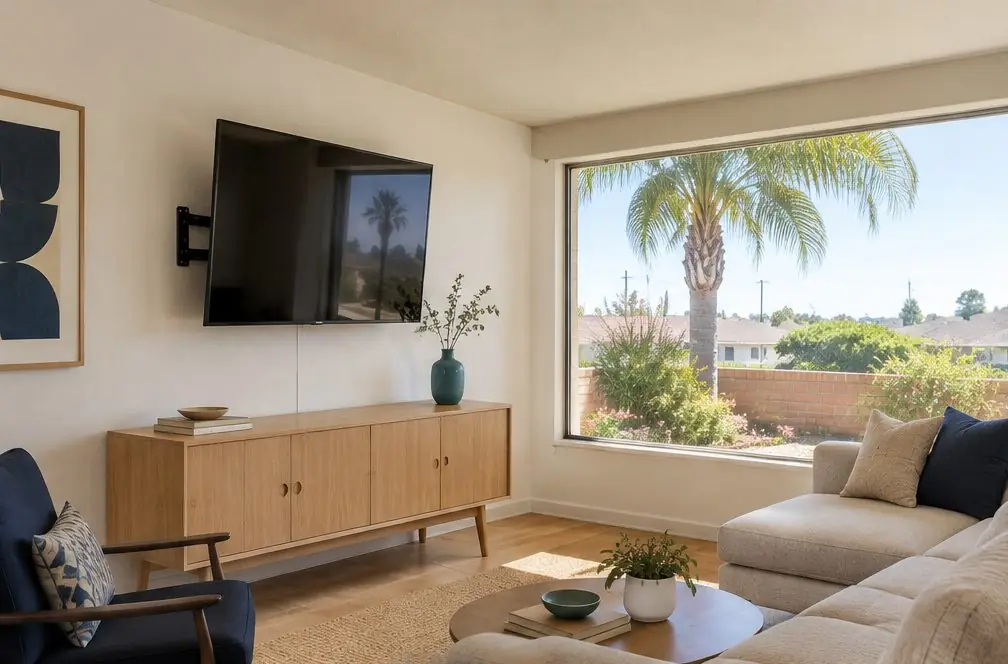
TV Mounting Level Garden Grove describes a typical job in a postwar west-side ranch house where the family-room wall is still original plaster: a 55-inch set on a fixed mount, studs confirmed by test holes before any bolt goes in, and a paintable channel carrying the cords to the outlet below.
Bookings aren't open yet. Leave your name and number; your message is recorded, and you'll get one message when a local installer is available.
Worked example. The pictures are AI concept illustrations, not photographs; no installation was performed or arranged through this site; prices are typical Garden Grove area market ranges, not quotes.
 Illustration
Project Examples & Typical Prices
The scenario
Picture a one-story postwar home where the family room opens onto the kitchen. Only one wall there is original plaster over wood lath; its neighbor was rebuilt in drywall when the kitchen was updated, so the two surfaces look alike but behave differently under a drill. The only receptacle nearby sits close to the baseboard.
The household wants a 55-inch screen that reads well from the couch and from the stools at the counter. Ceilings in this style of house run low, so the height is worked out from where eyes are when seated and then compared with the distance to the ceiling, not copied from a rule of thumb.
Cracks and visible repairs are the main worry. Old plaster chips at the edge of a hole and gives a stud finder confusing readings, which is why the framing is verified physically before the mount is placed.
What the job involves
- Masking tape on the wall shows the screen's footprint; the installer sits on the couch and slides it up or down until the middle of the picture meets eye level.
- A stud finder only suggests where wood might be. Thin hand-drilled test holes, made without the hammer setting, show where each stud actually begins and ends.
- A square of tape over each spot where a bolt will go holds the plaster together while a carbide bit, spun slowly, opens the pilot holes.
- Long lag bolts run through plaster and lath and bite into the studs; a laser line confirms the plate is level before the final tightening.
- Once the brackets are on the TV, the set is lifted into place and locked, and the picture is judged from both the couch and the counter.
- A slim channel covers the cords from the back of the set down to the outlet and can be painted to match the wall.
Hardware and materials
- Fixed flat bracket for mid-size screens
- Lag bolts and washers sized for plaster plus lath plus stud
- Carbide bit, variable-speed drill, masking tape
- Stud finder, laser line, thin test-hole bit
- Paintable cord channel with a snap-on cover
What it typically costs in the Garden Grove area
| 50–65 inch TV, standard wall mount (labor) | $115–$165 |
| Plaster over lath or early drywall (1950s–60s tract homes) | +$25–$45 |
| Typical total | $140–$210 (market range, not a quote) |
These are typical local ranges, not a quote or an offer; an installer prices the actual job after seeing the wall.
Add-ons often paired with this job
- Full-motion (articulating) mount — +$30–$50. Swinging the screen toward the counter needs an arm, and an arm asks more of the anchors.
- Mount a soundbar as well — +$50–$80. The bar gets its own bracket, screwed into the same studs below the TV.
- Take down an existing TV first — +$40–$80. Taking down an existing set and filling its holes is a separate charge.
Why it is done this way
Weight is rarely what harms plaster; haste is. A slow bit, a strip of tape and a few test holes take minutes, while a spidery crack costs far more to repair.
Cords go in a channel because cutting into plaster for them leaves a patch that seldom disappears, and the outlet is already within reach.
Remodels often swap out one wall and keep the next. A surface that appears to be drywall may be plaster beneath a thin skim, and one test hole settles the question, along with the right bit, speed and bolt length.
The plaster line in the typical range pays for this slower method. Adding a receptacle behind the screen belongs to an electrician and is outside this scenario.
What would change the price
- No stud lies under the planned center, so a wider plate or a backer board spans the gap.
- The plaster sits on masonry instead of lath, which calls for masonry anchors.
- A filled crack or old patch sits where the plate would go, so the plate shifts to sound wood.
- Stepping up to 65 inches changes the amount slightly yet keeps the same bracket.
- Cords hidden inside the wall require a rated in-wall kit, priced separately.
Where this leads
- Service page: Older Ranch Home TV Mounting — Mounts for the mid-century tract houses of Garden Grove, where the wall has to be read before it is drilled.
- Local page: TV mounting in West Garden Grove
- All services and typical prices: TV mounting in Garden Grove
- More worked examples: Project Examples & Typical Prices
Availability & price range
Check availability and the price range for this setup
Bookings aren't open yet — answer a few quick questions about the TV and the wall and get a typical Garden Grove price range right here. Typical Garden Grove prices for one TV, labor only unless an option says otherwise. This is a market estimate, not a quote.