
TV Wall Mounting in Garden Grove
TV Mounting Level Garden Grove covers everyday TV wall mounting across Garden Grove — living rooms, bedrooms and family rooms in a city built mostly of single-story ranch houses — where a local installer finds the wood behind the wall, sets a fixed or tilting bracket into it and dresses the cords.
Bookings aren't open yet. Leave your name and number; your message is recorded, and you'll get one message when a local installer is available.
 Illustration
What happens between the box and the wall
A mounting visit follows a fixed sequence, and the sequence is what keeps the screen on the wall.
- Read the TV. Weight, VESA hole pattern and screen width are noted, and the bracket must be rated for at least 1.5 times the weight.
- Mark the wood. A stud finder gives the first guess; a small probe hole in the spot the plate will cover gives the proof.
- Tape the outline. Painter's tape shows the screen size on the wall before any hole is drilled.
- Fix the plate. Pilot holes, lag bolts into the studs, a level on the plate.
- Hang the TV. The screen hooks on and the safety screws go in.
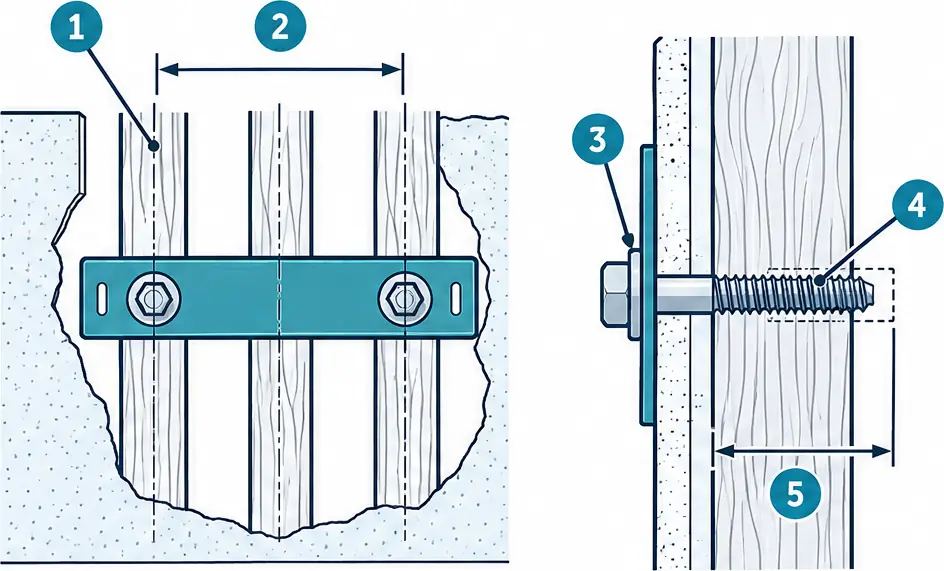
What the numbers show
- Stud center line A stud finder gives the edges and the bolt goes on the middle line between them.
- Stud spacing Studs usually stand about 16 inches center to center, so a wide plate can catch two of them.
- Washer and head The washer under the hex head spreads the clamping force over the plate.
- Threads in the wood The threads grip solid wood and stop inside the stud, after a pilot hole is drilled.
- Depth in the stud Most of the bolt length sits in the wood, well past the thickness of the drywall.
Fixed or tilting, and which wall suits which
| Mount | Best on | Trade-off |
|---|---|---|
| Fixed | A wall where the eyes meet the screen straight on | Sits closest to the wall, no angle |
| Tilting | A wall where the screen rides above eye level | Sits a little further out, angles the picture down |
In a Garden Grove ranch house with an eight-foot ceiling, the first choice is usually fixed. Tilting earns its place over a console or across from a front window, where a few degrees keeps reflections off the glass.
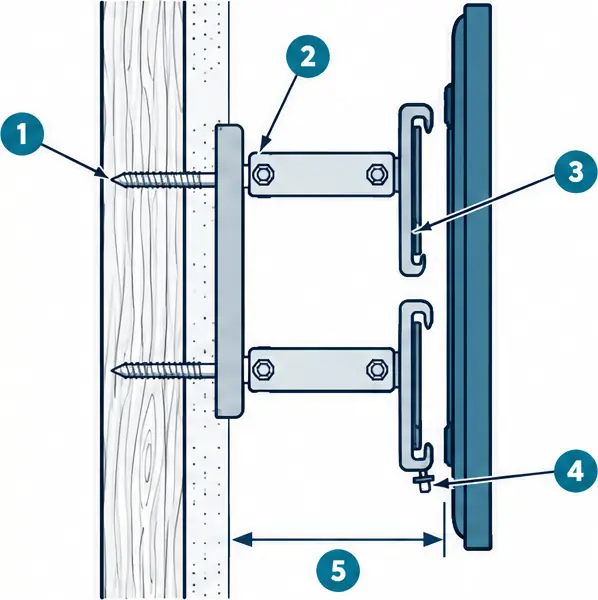
What the numbers show
- Lag bolt in the stud Each bolt goes through the plate and the drywall and ends inside the stud, so the TV hangs from the framing and not from the drywall.
- Rails on the plate An upper and a lower rail take the brackets; the plate is set level before the last bolt is tightened.
- Brackets on the TV Two brackets screw into the mounting holes on the back of the TV and hook over the rails; the mount must be rated for at least 1.5 times the TV weight.
- Locking screw A small screw at the foot of a bracket keeps the TV from being lifted off the rails by a bump.
- Gap to the wall The gap is just wide enough for plugs; a fixed mount has no adjustment once the TV is hung.
When the studs are not where the screen wants to be
Studs are usually about 16 inches apart, but a house that has been remodeled a few times seldom follows the pattern across every wall. A plate that spans two studs while the picture stays centered is the first answer. When the layout will not allow it, a backer board screwed across several studs gives the plate a solid face.
- Wide plate reaches two studs.
- Backer board spreads the load over three or more.
- Strap toggles are a last resort for a light set, never a substitute for wood under a large one.
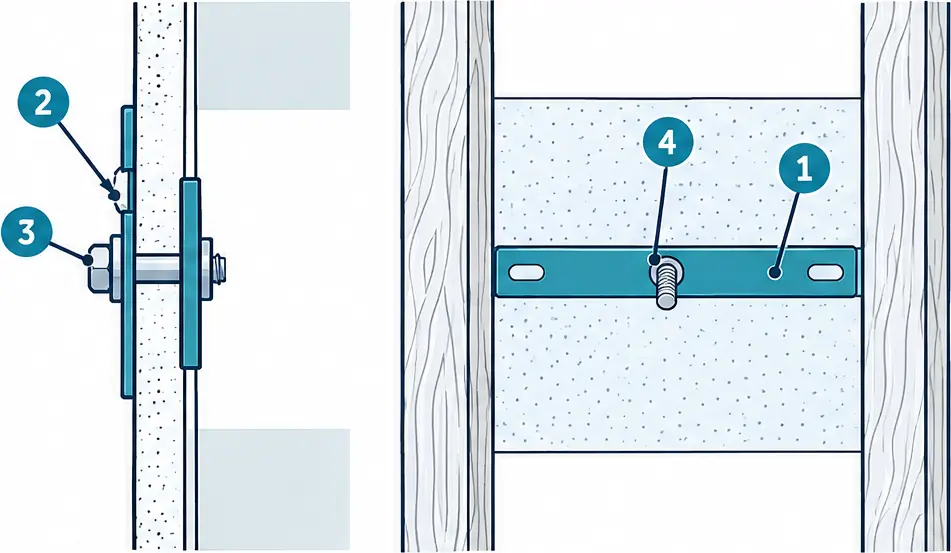
What the numbers show
- Steel channel A flat bar lies against the back of the drywall and is far longer than the hole is wide.
- Plastic straps Two thin straps pull the channel snug to the back of the board and are snapped off flush at the surface.
- Machine bolt A bolt runs through the plate and threads into the middle of the channel.
- Span across the board The channel bears on a wide strip of drywall, not on the thin rim of a drilled hole.
Cords and the finish
The simplest finish leaves the cords hanging behind the set and ties them in a short bundle with the outlet low and close. A slim surface raceway painted to match the wall tidies the run without opening the drywall. Hiding the wires inside the wall is a separate job with its own add and its own rules: a standard power cord never goes in a wall, only an in-wall rated kit does, and a new outlet is an electrician's work.
TV Wall Mounting — common questions
How much does a basic TV wall mount cost in Garden Grove?
Expect roughly $95–$135 for a 32–49 inch set and $115–$165 for 50–65 inches on drywall over wood studs in 2026. Larger TVs and harder walls move the figure up.
Does the TV need a special bracket?
It needs one rated for the TV's weight, with a hole pattern that matches the back of the set. A bracket the household already owns is checked against both before it goes up.
Availability & price range
TV Wall Mounting: check availability and price range
Bookings aren't open yet — answer a few quick questions about the TV and the wall and get a typical Garden Grove price range right here. Typical Garden Grove prices for one TV, labor only unless an option says otherwise. This is a market estimate, not a quote.