
In-Wall TV Wire Concealment in Garden Grove
TV Mounting Level Garden Grove covers in-wall wire concealment in Garden Grove homes — a clean line from the TV to the shelf through the wall, with in-wall rated power kits and CL3-rated HDMI — and the surface raceway that suits plaster walls, shared walls and rentals.
Bookings aren't open yet. Leave your name and number; your message is recorded, and you'll get one message when a local installer is available.
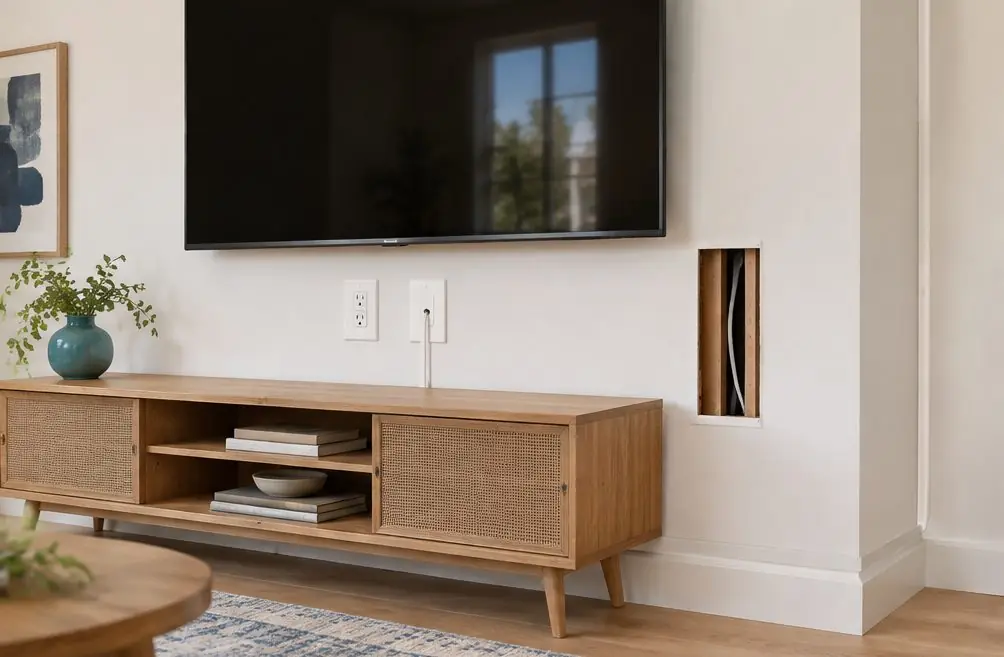 Illustration
What may go in a wall and what may not
Cables inside a wall must be built for it. A standard power cord or extension cord is not rated for in-wall use and does not go in.
| Run | Rated part | Why |
|---|---|---|
| Power | In-wall rated power relocation kit | Inlet and outlet plates, wire built for in-wall use |
| HDMI | CL3 or CL2 rated cable | Jacket rated for in-wall runs |
| Both together | Separate bays or separated lengths | Keeps power from interfering with video |
Plaster, drywall and what it takes to cut in
A cut-in in drywall is a small opening above and below, a fish line through the stud bay and a clean patch plate. Plaster over lath is slower: the plaster is brittle, the lath behind it can fight the saw and old homes can have fire blocking, insulation or knob-and-tube remnants in the bay. The installer scans and opens carefully, and a mid-century wall often takes a good part of the add-on to open and close. The plates are screwed to a framed opening, not held by plaster.
The power kit runs from an existing outlet
The kit connects to the outlet already near the shelf. It carries power from that outlet up to an inlet behind the TV, so the cord leaves the wall at the screen. New outlets, extending a circuit or moving an outlet is electrician work, so a TV that is not near any outlet needs a call to an electrician first. The installer does not add outlets or cut into live wiring.
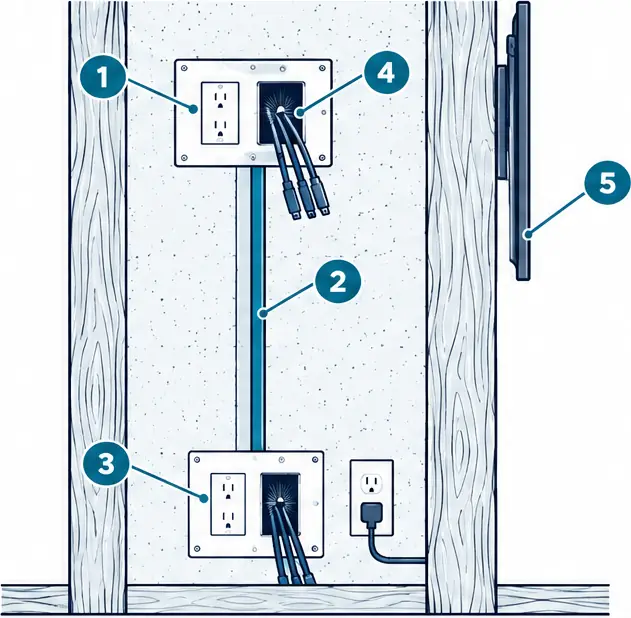
What the numbers show
- Upper outlet plate A recessed plate behind the TV holds the receptacle that the TV plugs into.
- Rated cable In-wall rated cable joins the two plates inside the stud bay; a plain cord is never used here.
- Lower inlet plate A recessed inlet near the floor takes power by a short cord from an existing outlet.
- Cable pass-through A brush-covered opening lets thin HDMI cables travel the same bay.
- TV in front The TV hangs in front of the upper plate, so the plug and the cables stay hidden behind the screen.
Shared walls and the raceway alternative
In condos, townhomes and apartments, a wall shared with a neighbor is often a fire-rated separation wall, and the association or the lease may limit what is cut into it. A recessed box or an in-wall run is not recommended on that wall; the usual choice is an interior partition or a different wall.
Where the wall should stay closed, a paintable surface raceway runs the cords from the TV to the shelf in a narrow channel that is screwed or adhered to the surface. It costs less than opening the wall, and it can be removed when the TV moves.
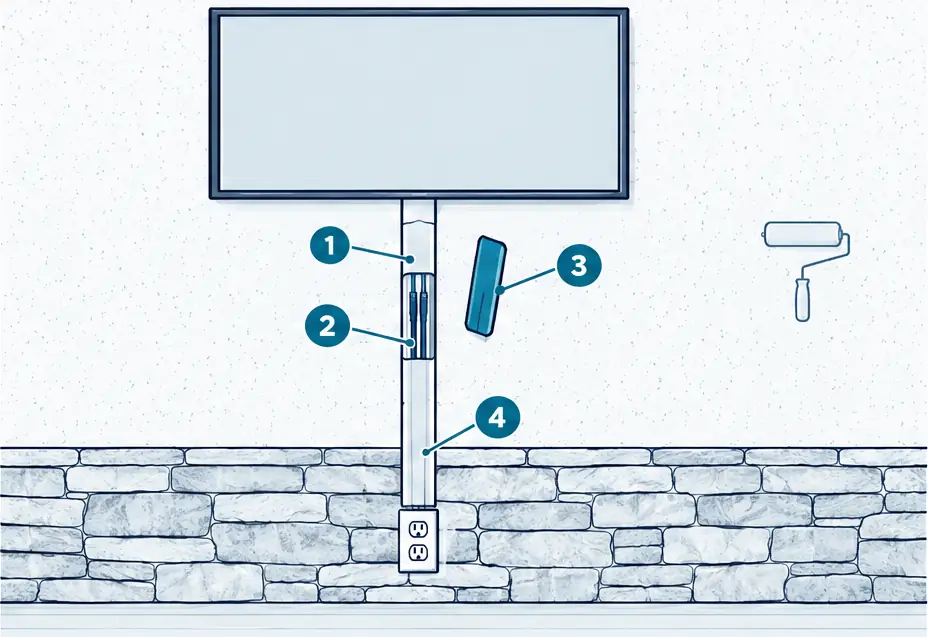
What the numbers show
- Raceway channel A slim base is fixed to the wall surface and the cables lie in it.
- Cables inside Signal cables and the TV power cord end at an existing outlet; no new wiring is added.
- Paintable cover The cover snaps on and takes paint to match the wall.
- Straight run A vertical run from behind the TV to the outlet looks tidy and comes off later.
In-Wall Wire Concealment — common questions
Can a TV power cord go inside the wall?
Not an ordinary cord; the wall run uses an in-wall rated power kit, and a missing outlet is an electrician's job.
Is a surface raceway a real option?
Yes, particularly for plaster walls, shared walls and rentals; it shows a narrow paintable channel but leaves the wall intact.
Availability & price range
In-Wall Wire Concealment: check availability and price range
Bookings aren't open yet — answer a few quick questions about the TV and the wall and get a typical Garden Grove price range right here. Typical Garden Grove prices for one TV, labor only unless an option says otherwise. This is a market estimate, not a quote.