
Older Ranch Home TV Mounting in Garden Grove
TV Mounting Level Garden Grove covers TV mounting in the 1950s and 1960s ranch and tract houses that make up most of Garden Grove — plaster or early drywall, low ceilings, studs that do not always keep their spacing and walls that have been opened and patched in a remodel or two — with a probe hole made before the bolts go in.

Bookings aren't open yet. Leave your name and number; your message is recorded, and you'll get one message when a local installer is available.
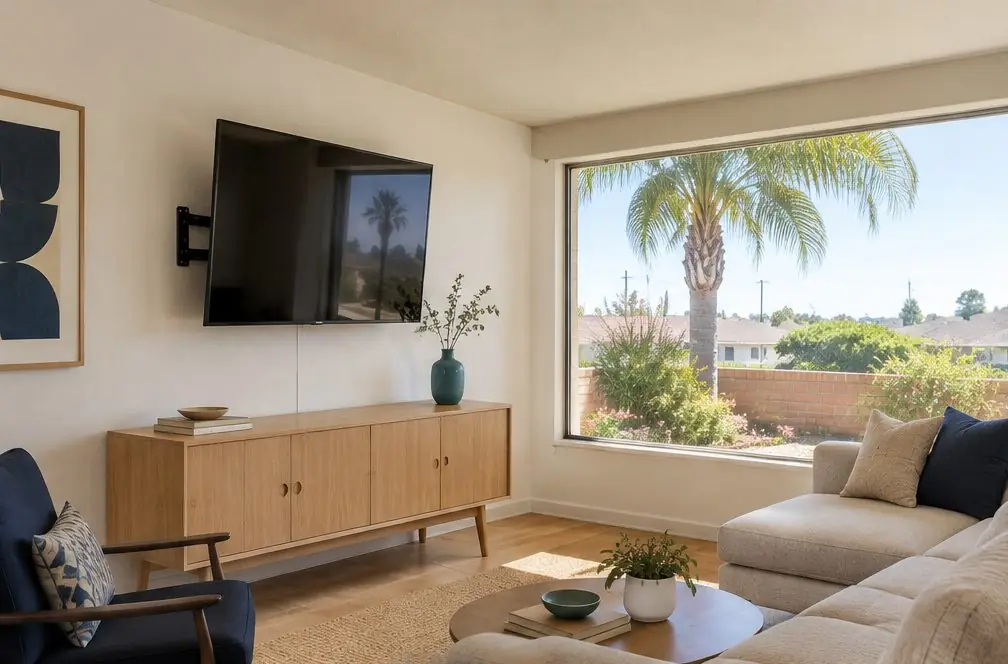 Illustration
Reading a wall that has been through seventy years
A mid-century Garden Grove house can hold three kinds of wall under one roof: original plaster over lath, early drywall hung when the tract was built, and newer board in the rooms that were remodeled. They sound and drill differently, and the finder does not tell them apart. The installer knocks, looks at old patches, and makes a small probe hole under the future plate to see what is behind.
Where plaster adds time and money
Plaster chips under a fast bit and lath hides studs from many finders, so the work is slower and the bolts are longer. The add shows in the estimator; on a standard TV size the totals look like this.
| TV size | Drywall | Plaster or early drywall |
|---|---|---|
| 32–49 inch | $95–$135 | $120–$180 |
| 50–65 inch | $115–$165 | $140–$210 |
| 66–85 inch | $149–$225 | $174–$270 |
| 86 inch and larger | $205–$309 | $230–$354 |
The plaster add is $25–$45 on top of the base range.
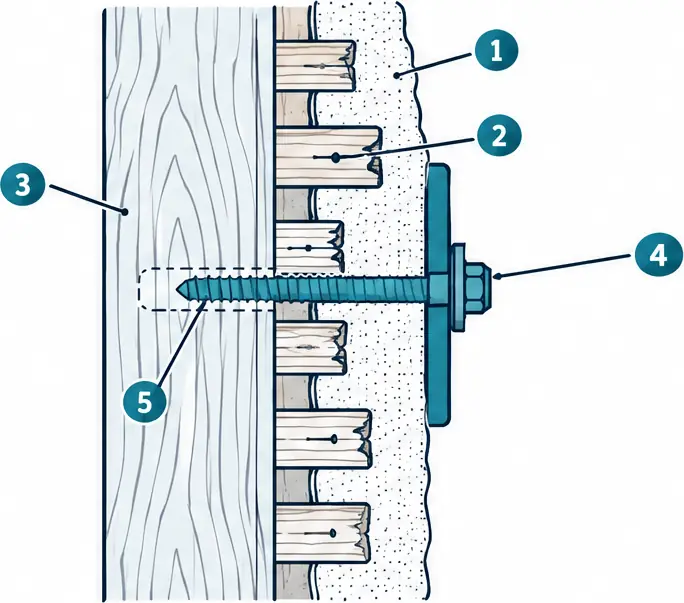
What the numbers show
- Plaster coat A hard, brittle layer that is only a finish; it cannot hold a bracket by itself.
- Lath strip Narrow wood strips nailed over the studs key the plaster to the frame.
- Stud behind The wood stud behind the lath is the fixing point for the plate.
- Long lag bolt The bolt is long enough to cross plaster and lath and still bite well into the stud.
- Pilot hole The hole is started slowly so the plaster around it does not crack or break away.
Studs that are not on a 16-inch grid
Framing in a 1950s ranch is usually wood, but the spacing can wander near a window, a doorway or a former opening. The installer proves each stud with the probe hole and fastens only into wood, using lag bolts long enough to pass through the plaster. When two studs do not line up with the mount, a backer board across them solves it without changing where the picture sits.
Eight-foot ceilings and remodeled rooms
Low ceilings make a screen easy to hang too high. The center of the picture belongs near the eye line of someone seated, and in a remodeled family room where a wall was taken out the old stud positions may no longer be where the newest wall puts them. A tape outline on the wall, checked from the sofa, settles height before any hole is drilled.
Seating distance and window glare in the family room
The rear family room of a ranch house usually sits beside a sliding door. A sofa 8 to 10 feet back suits a 65-inch screen, and the center of the picture goes near seated eye height, so a tape outline checked from the cushions comes before the drill. If the slider reflects afternoon sun on the dark screen, a tilting arm angles the picture down a few degrees, a full-motion arm turns it toward the seats, and a curtain does the rest.
Older Ranch Home TV Mounting — common questions
Is plaster harder to mount a TV on?
It takes more care and time, because plaster chips and hides the studs, so it carries an add of about $25–$45 per TV in Garden Grove. The mount itself goes into wood studs behind it.
Can a TV go on a wall with an old patch?
Often yes, once the installer has found the framing and checked that the patch is not covering something else. If the patched area is the only place a stud sits, the plate is fixed there only into the wood.
Availability & price range
Older Ranch Home TV Mounting: check availability and price range
Bookings aren't open yet — answer a few quick questions about the TV and the wall and get a typical Garden Grove price range right here. Typical Garden Grove prices for one TV, labor only unless an option says otherwise. This is a market estimate, not a quote.