
Full-Motion TV Mounts in Garden Grove
TV Mounting Level Garden Grove covers full-motion (articulating) TV mount installation in Garden Grove — corner positions in ranch family rooms, a screen that serves the kitchen and the table, dens with an awkward seating plan and apartments that need one TV to face two directions.

Bookings aren't open yet. Leave your name and number; your message is recorded, and you'll get one message when a local installer is available.
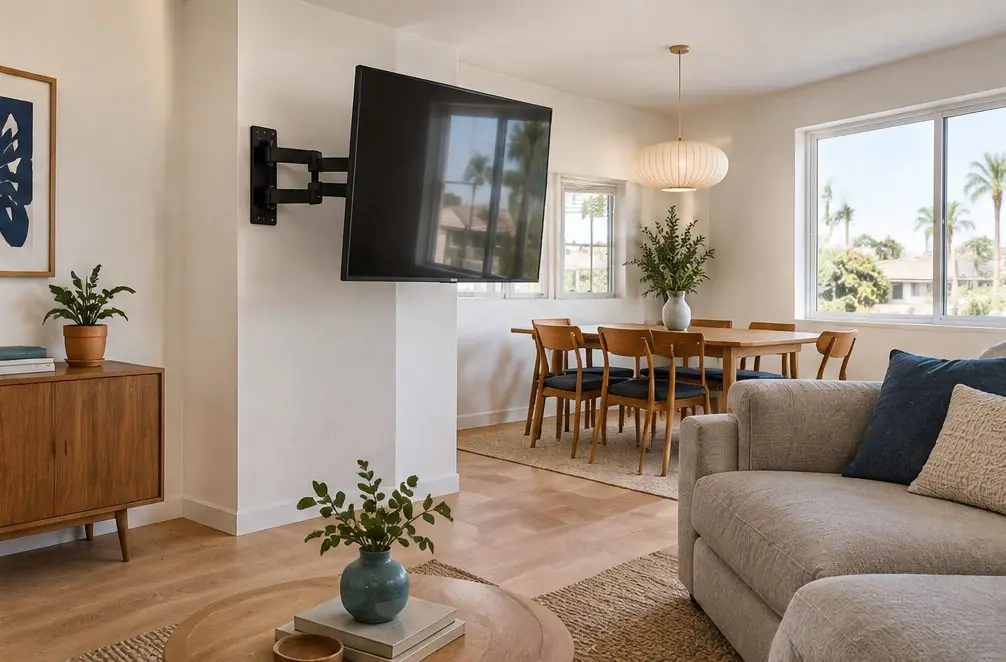 Illustration
Why the stud span matters
A TV sitting flat on a fixed bracket pulls straight down. An arm that is extended pulls down and outward at the same time, with the wall acting as the pivot, so the load on the top fasteners is several times the TV's weight at full reach.
Studs in most Garden Grove homes sit about 16 inches on center. A wall plate that spans two studs puts a lag bolt in each, and where the arm is heavy a backer board can spread the load further.
Reach, swivel and the swing of doors
The arm's published reach is the distance from the wall to the TV's back panel when fully out. The installer checks it against what is nearby.
- Doors and walkways: a swing that crosses a doorway can catch a passerby.
- Corners: the plate sits far enough from the adjoining wall to let the TV turn a full angle.
- Shelves and stoves: the screen needs clearance from a cabinet top or a range hood.
- Tilt at the end: a head that tilts up and down helps when the arm pulls the TV higher than the eyes.
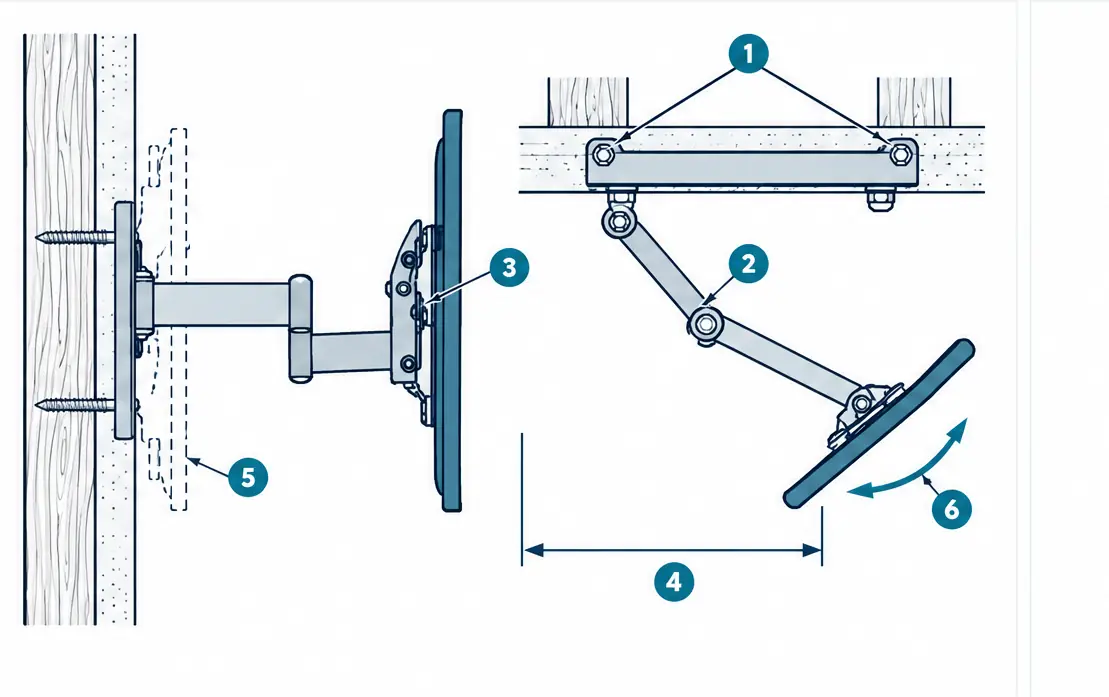
What the numbers show
- Plate over two studs A bolt in each of two studs resists the leverage that an extended arm puts on the wall.
- Pivot pin Round vertical pins at the elbow, the plate and the head are the joints the arm turns on.
- Tilt head The head at the end of the arm angles the screen up or down.
- Reach The distance from the wall to the back of the TV with the arm fully out; it decides what the swing clears.
- Folded position The dashed outline shows the arm folded and the TV resting close to the wall.
- Swivel The arm turns the screen toward a sofa, a kitchen counter or a doorway.
Kitchens, corners and shared rooms
A TV on an arm in an open kitchen can face the stove while someone cooks and then fold back to face the table. In an L-shaped living room it can turn from the sofa to the dining side. Heat and steam are a concern near a stove, so the arm is kept off the wall directly above a cooktop. Corners are tricky because the nearest studs may be two walls' worth of framing, and the installer maps both before choosing where the plate goes.
Cables that travel with the screen
A moving screen needs cords with give. The installer leaves a loop at the TV end and one at the wall end, uses clips along the arm and checks that a full extension does not pull a plug. Hiding wires in the wall is possible on a fixed mount but harder on an arm, because the cords have to leave the wall behind the folded TV and then bend through the joints.
Full-Motion TV Mounts — common questions
What does a full-motion arm add to the price?
About $30–$50 on top of the base range for a standard TV, plus the arm itself when the installer supplies it.
Can a swing arm hold a large TV?
Only within its rating and on a wall that can take the leverage; very large sets need a heavier arm and a wide plate on studs or a backer board.
Availability & price range
Full-Motion TV Mounts: check availability and price range
Bookings aren't open yet — answer a few quick questions about the TV and the wall and get a typical Garden Grove price range right here. Typical Garden Grove prices for one TV, labor only unless an option says otherwise. This is a market estimate, not a quote.